Friday, October 18, 2019

time to migrate south

Fall here on Cape Cod is a wonderful time of the year, bringing relief from crowds, bugs, heat, and humidity. And dogs are welcome on the beaches again here in Chatham! On the other hand, the water rapidly chills and weather gets darned unstable: the fall here brings in the north-easters, nasty low-pressure systems from the south that suck in strong winds from ahead of them....and one sat to our south for three or four days last week...I lost count after days of rattling windows (Lucy and I are staying ashore, visiting my mom and relatives) and spitting rain. And another, briefer and far more violent, came through just a day ago, bring in some nasty winds of over 100mph in some parts of the Cape. Both brought damage to boats that dragged their moorings or otherwise came loose or swamped (my mizzen got a bit ripped, but should be easy to repair). Occupy Chatham is getting close to the waters edge (10' now vs 30' a month ago and 100' last summer).
A new break has formed in the barrier beach just off Morris Island.
This 3-part dinghy dock is supposed to be straight.
Blowing sand created drifts and dunes..


And here I have remained, waiting for my propeller to come back from the shop... which was finally repaired and tuned Tuesday. They replaced the chip nicely, welding in some new metal, and everything is now tuned (I hope) so I don't get those nasty vibrations when the wind picks up. Some discoloration shows where corrosion occurred before I bought the boat, when it sat for years in NC, probably with no sacrificial zinc to protect it.


The new bowsprit collar I designed and a local shop welded up looks very sturdy and should surely be far more sound than the old cracking one. 


Wednesday, I dove under the boat and reinstalled the prop. And, now that winds are dying back to reasonable levels, I am ready to GO!

My friend Larry, from Coral Bay and New Jersey, has joined me and we plan to head out today for Delaware Bay, avoiding the patches of interesting weather so prevalent this time of year. Another friend, Kent, says this would be perfect for heading out to Bermuda, using these north-west winds today to sweep down across the Gulf Stream and south, getting to the Virgin Islands in about three weeks.... Tempting, but I'm not ready to take that leap yet. 

I had hoped to meet Cynthia in Norfolk, VA, on the 23rd, but forecasts show some nasty knots of weather possible, so I'll head toward Delaware Bay and see how the weather looks as I get closer. Either she will wait there in the Norfolk area for a day or so while we make our way as weather permits or she can rent a car and drive north. We shall see...

Lucy has been really enjoying the beaches and, as well, taking some time each day to practice for a long and boring sail.


I'm sure looking forward to getting out to the boat this morning, making sure nothing serious has failed in the most recent storm, making our way past any new shoals in the harbor entrance, and setting sail again. It has been WEEKS since I raised sail!

Wish us luck!

PS: Cynthia will fly out with Lucy around Nov 6, to work etc in MI. I will wing to CA to visit parents for a ten days or so, leaving the boat in a marina.... maybe in NC. Then back aboard and... what? A three-week sail to the Virgins? FL and Bahamas? We shall see... Whatever happens, I need to get down to warm water before Cynthia (& Lucy) joins me for most of the winter. 

Wednesday, October 2, 2019

Making repairs

One of the problems of living in a boat...or a house, for that matter... is the need for repairs and improvements. One could also say that one of the great things about living on a boat is the constant opportunity for exercising problem solving skills! Whether one sees the glass as half-empty or half-full, here are a few current items on my mind: the boat has leaks into the core of the deck, but that is not an urgent issue... as long as I store things in plastic or glass containers. My water pressure pump has been running a lot sometimes... could it have leaking pipes or need replacing? The roller furler for the jib worked poorly so I had to replace the bearings. The halyards for the sails still chafe, but not all the way through... so I put tape on as a bandaid... and really should climb the mast to make another attempt to solve it. None of these problems are really huge....

On the other hand, I'd REALLY like to solve the problem of the propeller vibration (before it damages the cutless/cutlass bearing or anything else) and have been diving under the boat to remove it... but the thing is VERY securely installed and I'm unsure about how much force to use. I'll try again today and, when I succeed, will bring it to the specialists in Salem. (Success is mine! I released it Tuesday morning and dropped it off with the prop shop in Salem at about noon!
They say seven to ten days and I sure hope this solves many problems.)

Far more essential is a crack I found forming in the bowsprit collar. This fitting serves as the attachment point for the bobstay and forestay and two whisker stays and resists immense forces.... and is cracking.

Ignored, it would probably fail within the next year, probably in the worst possible conditions. So, I've ordered a nice piece of 316 stainless pipe a foot long and contacted a local machinist to weld me up a replacement.

Another essential repair: I'm working to repair and reinstall the largest remaining section (about 5 feet) of the port jib traveler track (it broke in June and I pulled the remaining bits out a few days ago).


Part of the wood it should anchor into is certainly stronger than sponge... but not by much... so I'm depending on the fiberglass that encased the wood. 
The temporary repair I've set up should work ok until I do something more permanent in a few months. Anyway, I may need to take it all apart to fix the leaky deck, and will figure THAT out over the next few days.


It looks as though we are in for a period of gray and windy weather... so I get to work on interior items like painting and adding shelving. I can dive under the boat to re-install the sacrificial anode on the propeller shaft. Perhaps replace the packing on the propeller shaft as well, since that has been dripping a good bit....although I wonder if I may need to replace the shaft.... (hmm......how might I do this in the water without sinking the boat? Hmmm...interesting challenge). And I can order the materials I need to work on things like re-coring the deck. 

Wednesday, September 25, 2019

Maine trip!

As I imagined living on my boat, I planned on sailing up to the NE coast in late spring, stopping in to Cape Cod, then moving on to Maine. I figured on sailing back south to the Cape and then north to Maine a few times in the summer.... At least Cynthia and I made ONE trip up to Maine!

We set sail after spending the night anchored at Monomoy, about four miles south of Chatham.
The south and of Monomoy is known as a treacherous area (and actually caused the Pilgrims to turn back and head to Plymouth), so I paid close attention to charts, satellite photos, channel markers, and my eyes as we made our way around. The shoals move slowly and the charts have clearly not been updated.... and it didn't help that Cynthia hooked a big bluefish (lifetime best?) as we passed through the narrowest bit. She pulled the first fish aboard,
then quickly hooked a second which bent the hook and escaped.

Several miles out to sea and well away from unsafe water, we relaxed in a gentle breeze that swept us steadily north. Half of the bluefish joined us for dinner after we enjoyed a beautiful sunset.

In the darkness, the occasional lobster buoy tapped it's way along the hull and fell behind and, once, I was startled by a very large sigh nearby....probably a fin whale taking a breath before heading down again. Sparkles in the water, stars in the moonless sky, distant lights on shore.... very peaceful.

Sunrise found us at Stellwagen, a small detour and delay, but one that Cynthia really wanted to try as this is a fabled fishing ground known for it's huge bluefin tuna. She woke, set out her line, and we made our way between other fishing boats and lots of lobster pots. Very crowded, no bites... so we continued north.

Then it hit, the rod bending, the reel singing as the line zipped out even with the drag at maximum. Cynthia tried to get me to do what she needed, but we could not maneuver the boat well with the jib out and the mizzen sheet (the lines holding the mizzen boom) were in the way and, after an eternity of screaming and epithets that probably lasted two minutes, the line parted and the fish and expensive lure departed. Looking about we saw no sign of the fish... but after a few minutes heaved-to saw a small ocean sunfish gently turning in the boat's turbulence. We let the emotions simmer down, assessed damage, and worked to figure out a strategy "for next time". One ought to learn and improve from experience rather than simply grind teeth....

Eventually we made it to Maine where we stopped in to Monhegan Island (artists painting, beautiful hiking, rudder hit a rock in the night even though we were on an assigned mooring),

Isle Au Haut (beautiful hike, clams to dig, solid anchoring overnight, little wild cranberries),


made our way north (sailing near a schooner for a bit)
to Buck Harbor for two nights (comfortable moorings, friendly folks, nice chat with Marina owner John Buck, outdoor showers, great shelter from remnants of hurricane Dorian),
and spent our final night in a little cove in Merchant's Row (good anchorage, incredible numbers of monarch larvae, some softshell clams, and a beautiful place to walk...

but anchor line ended up tangled with lobster pot line in the morning and fisherman came by before we freed it... but was friendly). Then we set course for Cape Cod, planning to get back in time to take Cynthia to catch her flight to Boston. But...

About a day later, motoring along with very limited wind, the engine started revving a bit, perhaps once every ten minutes. I'd read up on this when we had the problem a few days earlier, diagnosed it as a clogged fuel filter, and changed the primary filter.... but now the problem was recurring and the primary filter was clean.... meaning I needed to change the secondary filter. And THIS was beyond my knowledge.

We set sail for shore, for whatever place would be nearest and most convenient. In order to make sure we had enough engine when we really needed it, we ran on sails only, despite the low winds....probably a mistake as I could have called for a tow under my insurance policy once near shore. Still, we sailed toward shore and the closest harbor, Kennebunkport. Once near it, we found their prices high and their port shallow, so continued on a very rough night toward Portland, by morning very much wishing we had simply risked the shoals and paid the price.

As we neared shore, passing Portland toward a promising anchorage and nearby marina, wind died down and so did the waves, Making our way past shoals and islands in blessed peace, tide sweeping us toward our destination, sun rising, we picked up spilled clams from the deck and enjoyed the morning. Dropping anchor, we relaxed and called the marina... and they said they could get us in that morning! We pulled anchor and set sail... then gave up on the light wind and changing current and started the noisy engine and shortly pulled up to their dock.

After a chat with a service manager, he sent Josh out to replace our secondary fuel filter and give me a lesson on how to do it. SO, now I have the tools and know-how to handle a filter change OR handle it if I ever get air in the lines in rough weather or if I run low on diesel. I had also been worried about possible damage to the boat from hitting the rocks at Monhegan Island... and I had a new propeller to install, so Charlie had us lifted out of the water
where we found (to our delight) that we only had a could scrapes on the rudder and no sign of other damage.... and found (to our dismay) that the propeller I had bought was incompatible with my boat. Well, two successes, one failure.... and nothing that has damaged us in any permanent way.

After a night on the hard, we made pancakes with our wild cranberries and some huge commercial ones.
Once the yard guys arrived, we dropped the boat back into the water,
Cynthia (out of time to get to her flight) took a very convenient bus from Portland to Logan airport, and Lucy and I set sail, sorry to leave the delightful marina, new friends, and whimsical signs.

We motored a LOT when the wind failed (most of the day and night), then sailed along under less and less sail as the north-east wind increased as we passed Provincetown. Lucy, nervous as first, relaxed,
although she had trouble standing on three legs to pee. Rough weather!


Partway through the day, my mom called to ask where we were, wondering if the little white dot they espied off Eastham might be us.
Probably, we decided. After a couple minutes she pulled out her binoculars, spotted my brown mizzen sail, and we knew for certain!

By evening, we rounded Monomoy and, at sunset, dropped anchor in my favorite spot, happy that the wind direction made it a sheltered spot. I thought about taking Lucy to shore for a walk, but she seemed quite happy to pee on her astroturf and we went to bed, sailing into Stage Harbor early the next morning.

So... sailing to and from Maine seems to be rougher than I like, so is not something to do several times a summer unless conditions are just right... so NOT on a set schedule. Maine itself was beautiful, but chilly this time of year. The boat works wonderfully for lobster pots, not hooking any lines or buoys, making sailing up there far more relaxing than a normal boat. I think I'd like to do it again. And next time I'd like to go farther east and do lots more hiking... and be there for blueberry season!

Monday, September 16, 2019

Monarchs in the Maine islands

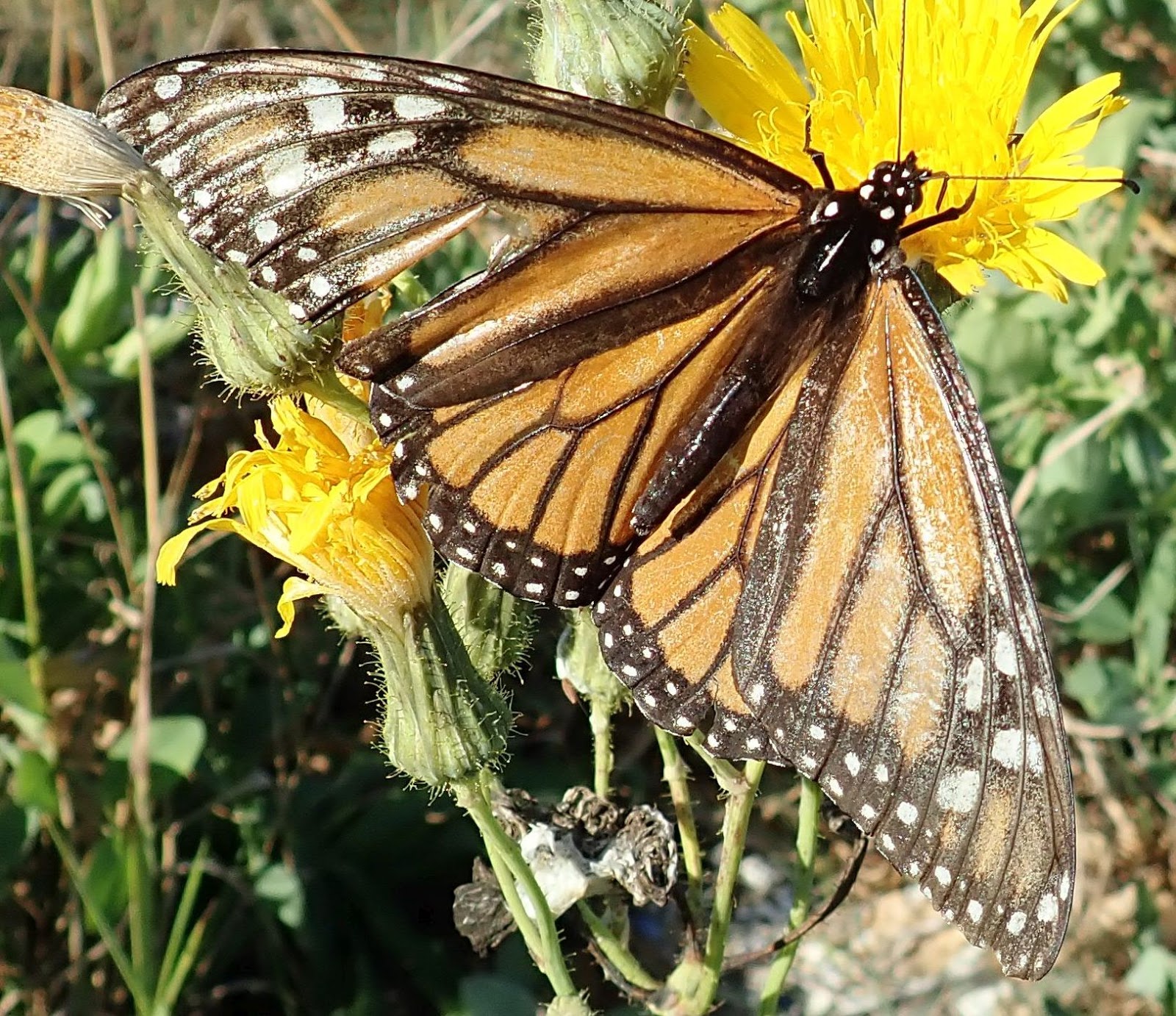
The islands are known for their dark covering of evergreens and moss, but in the occasional patches of open grow blueberries and blackberries, cranberries.... and sometimes milkweed. And the favorite food of monarch butterfly larvae is milkweed leaves. Unlike the milkweed in MA or MI, where I might search ten minutes without finding a larva, the patches I've found on Monhegan Island and another
teem with the little critters,
often stripping stems bare of any leaves to the point the larvae must set out on a dangerous journey to find another plant, one that still has leaves.


We also wondered at the small larvae present at such a late date: surely frost will come soon and kill the remaining larvae.... why would the adult keep producing eggs rather than heading south? We even saw one mating, an obvious waste of energy.

Further thought made this behavior far more reasonable. I think this tattered adult, still mating and (probably) laying eggs gave a clue: it has zero chance of struggling very far south, of beating old age and the advancing frost of fall.

On the other hand, the frost might come late enough for it's offspring, vibrant and young and strong, to wing their way south and pass on genes.
So... the opportunity cost of laying eggs is zero as there is nothing else it could do to pass on it's genes.

Yes, I know some folks might simply enjoy the beauty of nature, but I like to look and wonder and understand.

Then again, there IS the simple beauty to appreciate...


Monday, September 9, 2019

A sunken boat

I'll try to get out a bunch of blog posts soon to catch up on events. Pretty much everyone in my extended family has caught bluefish off the sailboat; we've had a few nice expeditions to Monomoy; Lucy got a haircut; Lucy learned to make long ocean passages fairly comfortably; Cynthia, Lucy, and I are currently on a short trip to Maine (and are anchored at an island infested with Monarch butterflies); and my brother's dog Bailey stayed with my mom for a month while his family traveled.

What else.... hmm... ah, yes, there was the line wind, combined with tornadoes, that ripped through the Cape, taking down trees, leaving folks without power for days, and sinking one of the family sailboats. 


On July 23 I drove to Hyannis to pick up Cynthia. In the hour or so before she arrived the wind howled and I had to pull over and simply wait. When we returned to Chatham, most homes had no power and trees blocked many roads. My boat seemed to be in fine shape, at least viewed from shore, but my uncle Bob called to say our family sailboat, a Mariner (19'), had sunk at the mooring and looked as if it were sinking further. We drove over to investigate.

Cynthia, Lucy, and I rowed out in a small rowboat suitable for smooth water and only took water over the side a few times. I snorkeled around the boat and found the current had driven the top of the mast into the sand and that the stern had sunk to the bottom with the outboard engine still attached.

So... attached a float to the outboard and released it from the boat so my cousin Peter and his son Sam could pull it from the water.

Then I tied a couple floats to the top of the mast, fighting the strong current,
and finally getting that loose from the sea bed. The stern, even relieved of the weight of the outboard, still sat firmly on the sea bed. And we were tired of fighting the current. We contemplated...
and resolved to return at slack tide the next day with fresh eyes and new plans. I swam to shore... and found the lost engine cowl about halfway in!

The second day's attack involved adding floats to the stern until it lifted from the sea bed, then using anchors and lines to swing the boat toward shore into fairly shallow water at high tide so that low tide would leave it in shallow water enough for us to empty it of water. This worked: we brought it near shore in the evening at high tide, then emptied it with my mom's assistance at low tide the following day.


Emptied, the boat floated well and we put it back on the mooring. Of course, there was all the cleaning and rinsing and sorting of cushions etc. And one of the companionway boards had floated off, so I fashioned new ones with salvaged plexiglass given to me in NC by Rick, the marina carpenter. And a week or two later, we sailed it around to Stage Harbor, pulled it from the water, and trailered it back to the house. Now the boat is safe, sound, and back in the driveway on it's trailer for the winter. But we really DO need to handle the lack of good flotation in the stern, a problem that caused most of our difficulties in getting the thing back upright.

As far as the rest of the town? Huge effort got trees cut up and power restored within two days. In the meantime some folks moved to hotels or stayed with friends who had generators. Cynthia and I simply moved onto my boat where we still had our solar power and refrigeration.

Having lived through this little storm and lost a boat to hurricane Irma, our hearts go out to those in the northern Bahamas who are going to need months to years to get back to normal.